How to Get Your Ghost Blog Cited by ChatGPT, Perplexity, and Google AI

Your readers are asking ChatGPT and Perplexity instead of Googling. If those answers don't cite your blog, you're invisible: no ranking, no click, nothing. Here's how to get cited, with most of the work happening right inside Ghost Admin.
Quick vocabulary so the rest makes sense: GEO (generative engine optimization) is getting cited inside AI answers; AEO (answer engine optimization) is being the clean answer Google's AI Overviews pull from. Same work, mostly. And it's not a separate dark art: Google's own guidance says its AI features draw from the regular Search index, so the SEO basics you already do are what make you eligible.
How the engines pick sources (the 60-second version)
- Google AI Overviews / AI Mode: pull from the normal Search index. No separate AI ranking, no special trick. If you're indexed and crawlable, you're in the running.
- ChatGPT: uses three different bots, and mixing them up is the #1 mistake. Per OpenAI's own docs: GPTBot is for training, OAI-SearchBot is the one that gets you cited in ChatGPT search, and ChatGPT-User fetches a page when someone asks. Block GPTBot and you only opt out of training — you stay in ChatGPT's answers. To show up there, you must let OAI-SearchBot crawl you.
- Perplexity: fetches live pages, loves recent content and hard numbers, and leans heavily on Reddit.
ChatGPT and Perplexity barely agree on who's worth citing — one 2026 analysis of 680M citations found only ~11% of domains overlapped. So don't optimize for one engine; optimize for clarity, which all of them reward.
What to actually do in Ghost
Princeton researchers tested nine tactics across 10,000 queries (KDD 2024). The winners: add statistics, cite sources, write with authority. Keyword stuffing did nothing. Here's how that plays out in Ghost.
- Answer in the first paragraph. Retrieval engines quote your intro, so put the actual answer up top — not three paragraphs of setup. Drafting with Postmancer's Ghostwriter? Feed it your target question and it writes an answer-first draft, plus a meta description, straight into the editor.
- Use real numbers and cite them. This is the strongest finding in the research — stats and visible source citations lifted AI visibility by up to ~40%. Link out to primary sources and keep the citations on the page. Ghostwriter can build in citations and a key-takeaways block.
- Make it skimmable. Question-style H2s, short paragraphs, a comparison table (Ghost's Markdown card), and an FAQ at the bottom using Ghost's Toggle cards. Those are the exact chunks engines lift.
- Publish something only you have. Poll your Ghost members and write up the numbers. First-party data gets cited because nobody else can copy it.
- Keep old posts current. Recency matters, especially to Perplexity. Updating one phrase across 200 posts is brutal in Ghost by default — Postmancer's Find & Replace swaps an old stat, product name, or link across your whole archive in one pass.
Don't accidentally lock the bots out
Ghost already nails the basics: fast pages, an auto sitemap at /sitemap.xml, and Article schema in most official themes — exactly what Google asks for. Two things are on you:
- Fix your robots.txt. Allow the search crawlers — OAI-SearchBot, PerplexityBot, and Google-Extended. You can allow these and still block GPTBot if you don't want to feed model training. Ghost serves a default robots.txt; override it by adding one to your theme.
- Add an llms.txt (optional). A small file at your root that maps your key pages. Nice-to-have, not essential.
See who's actually citing you
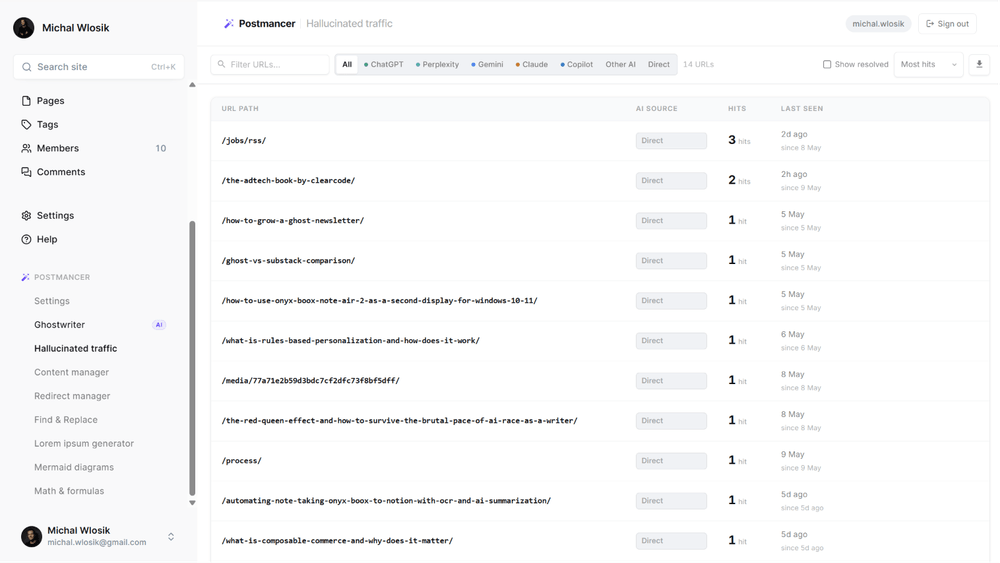
This is the part every other guide skips. Most AI engines don't pass a referrer Ghost recognizes, and when an AI links to a page you never wrote, that visit never shows up in your stats at all.
Postmancer's AI Traffic Insights catches it. It logs visits from AI tools, tells you which engine sent them, which URL they wanted, and how often.
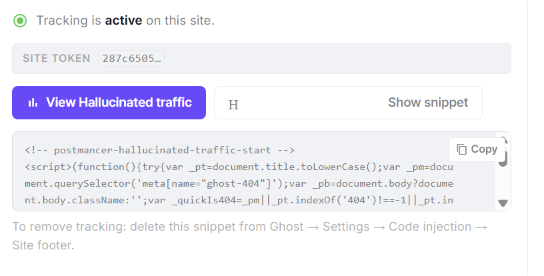
Setup is one step: paste the beacon snippet into Ghost → Settings → Code injection → Site footer. It runs invisibly and starts logging — dead ends included.
Turn dead links into citations
Here's the pattern you'll spot within days: an AI recommends you, then links to a page you never wrote. The reader hits a 404 and bounces. That's a citation the AI is trying to give you — you just haven't published the page.
From the panel you fix it without leaving Ghost: write the missing post (Ghostwriter drafts it on the spot) or point the bad URL at your closest existing post with Postmancer's Redirect Manager.
[Suggested screenshot: a real ChatGPT, Perplexity, or Claude answer citing your blog, with the source link visible — great proof shot near the top of the post.]
Your first week
- Day 1: Check robots.txt. Confirm OAI-SearchBot, PerplexityBot, and Google-Extended are allowed.
- Days 2–3: Rewrite the intros of your five best posts to answer the question up front. Add a stat and a real citation to each.
- Day 4: Drop in the Postmancer beacon. Watch which engines cite you and which URLs they hallucinate.
- Day 5: Fill the top hallucinated URLs with posts or redirects.
That's it. Be crawlable by the right bots, answer fast, back it with data, keep it fresh — then watch what the AIs do and close the gaps.
Install Postmancer free and see which AI tools are already sending you readers — and where they're hitting walls.
Sources
- Google Search Central — official guidance on AI features and optimization
- OpenAI — Overview of OpenAI Crawlers (GPTBot vs OAI-SearchBot)
- Aggarwal et al., GEO: Generative Engine Optimization, KDD 2024 — arXiv:2311.09735
- Cross-engine citation overlap analysis (2026) — Leapd